Magazine article
The Paintings of Harold Feist
Artmagazine · February / March / April 1982 · pp. 50–53
View PDF (11.7 MB) ↗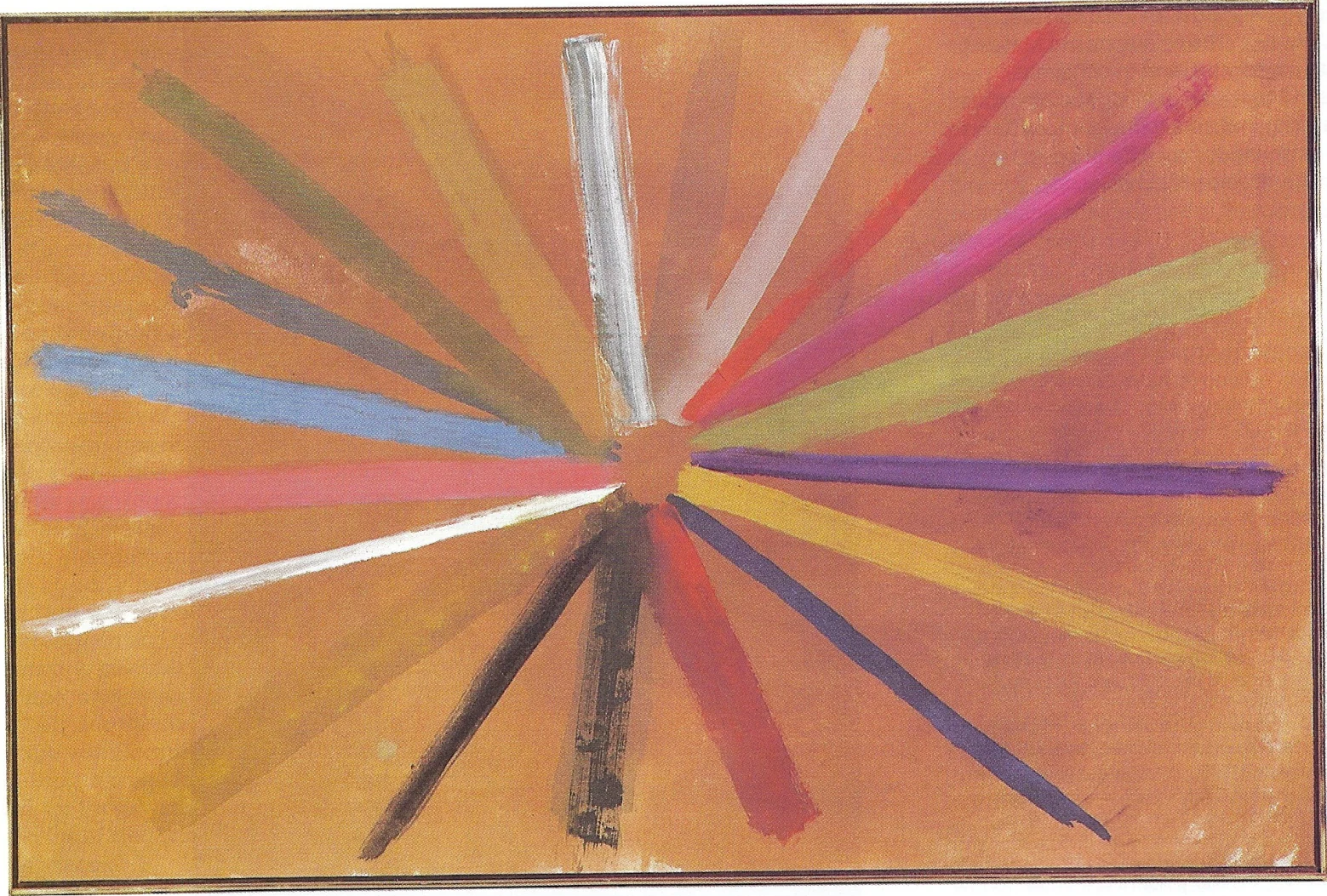
Harold Feist’s energetic, radial images have attracted a good deal of attention in the past two years. He's had successful one-man shows in Toronto, Edmonton and Boston; several U.S. and Canadian museums have acquired his work, and he was included in the “First Annual Emerging Talent Exhibition” at André Emmerich Gallery in New York. But despite the impression that Feist burst full grown onto the Toronto art scene, he’s not a newcomer. Quite the contrary, he’s a painter who has exhibited steadily for more than ten years and who has been included in many prestigious group shows during that time.1
He's been peripatetic, though, living in Calgary, Regina, the Maritimes and (briefly) New York — on a Canada Council grant — before settling in Toronto at the beginning of 1979. He’s been no less wide ranging as far as the development of his painting is concerned, pursuing and abandoning new directions in a restless effort which, at times, appeared to be a prodigal expenditure of ideas. Feist has made many different kinds of pictures, so that the whirling “spoke” format which has preoccupied him since about 1978 could be seen as just another type, albeit his best and most consistently successful one to date. Yet for all the apparent variousness of Feist’s painting of the last decade, the spoke pictures are a logical, perhaps inevitable result of what came before. It's as though he spent those years dissecting notions about color, gesture, texture and structure which are now summed up in his recent works. This, however, sounds more systematic and dispassionate than, I think, the process was. Feist is at once a sophisticated, knowledgeable painter and an almost blindly instinctive one. He has always seemed to operate out of a contradictory combination of enormous visual intelligence and an odd sense that his paintings were controlling him, rather than the other way around. The evolution of his recent pictures has been correspondingly complex and paradoxical.
I first became aware of Feist's paintings about the time I began working at the Edmonton Art Gallery. My first task, a legacy from my predecessor, was an unwieldy juried show, West ’71. Among the hundreds of submissions by professionals and amateurs, only a few stood out. Dorothy Knowles’ and William Perehudoff's pictures severely criticized those by many of their colleagues, but there were also two distinctly strange but unignorable works by an unknown called Harold Feist. They were large, murky stain paintings, scrubbed rather brutally onto the canvas. The color was no less brutal — bottle green, rude purple-pink, an aggressive blue — and isolated in crude geometric compartments by slapdash lines. They looked unlike anything but themselves, but bizarrely, they suggested clunky, oversized versions of Paul Klee.
The juror, Kenneth Lochhead, was fascinated by the Feists and recommended one of them for a purchase award. It must be reported that we didn’t follow his suggestion. The Acquisition Committee, and I along with them, went for Knowles and Perehudoff, (Feist has since joined the collection of the Edmonton Art Gallery.) But his pictures in West ’71 were impressive and arresting enough that I began visiting his studio in Calgary. I discovered that he had been trained in the U.S., at the University of Illinois and the Maryland Institute College of Art, before emigrating to Canada in 1968. The works I had seen in West '71 came out of early minimalist preoccupations: grid-generated images, which led to grids slashed diagonally, and eventually to sections of the slashed grid becoming the whole picture.
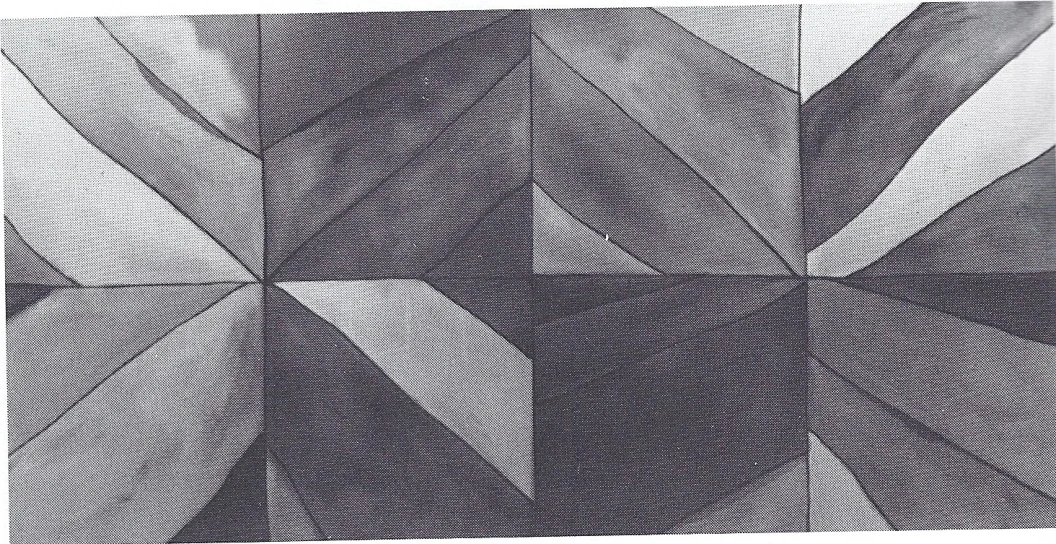
There was a remarkable sense of struggle in these paintings, a battle between instinct and theory which gave them a peculiar kind of energy. Their geometric structure seemed to have been arrived at by deducing a subtly varied set of regular internal divisions, Mondrian-like, from the vertical and horizontal givens of the shape of the support. The diagonals which bisected the deduced grid were themselves arrived at by joining a set of given points at more or less regular intervals, but each section of the canvas seemed autonomous. Feist has since said that in making these pictures, he thought of himself “almost like a brick-layer, painting one section and then another, until the canvas was filled”.2 But the way these pictures were painted had nothing to do with dispassionate logic; they were crude, deliberately hand-made, messy, suggesting that the artist had subdued a recalcitrant medium by force. It seemed as though Feist was looking for a neutral format which would allow him both to demonstrate and control deep feelings.3
Certainly the paintings which followed bore out this notion. After attending two artists’ workshops at the Edmonton Art Gallery, led by Stephen Greene and Michael Steiner, Feist’s paintings became simpler. The drawn grid — which he had once referred to as the “bones” — disappeared and the pictures became loose, gestural accretions of close-valued color. The obvious thing would be to point to the influence of Jules Olitski, a not altogether improbable idea, since a considerable amount of his work was starting to be seen in Alberta at the time. But I think the density and brushiness of Feist's pictures was also an inevitable result of his having abandoned both geometric structure and clear internal divisions. When drawing dominated, and when color was contained in discrete areas, as in the grid pictures, there was enough visual incident to make textural inflection unnecessary — or rather, the picture was already so complicated that it needed the literal continuousness of staining to hold all the various elements in place. Once the internal divisions were gone, as they were in Feist's gestural pictures, he had to rely on a new kind of structure — one which grew organically out of the layers of close-valued paint. Most importantly, the new approach demanded that he remain alert to things which developed as he painted, instead of filling in preestablished zones, as he had in the grid pictures.
Over the next few years, Feist's paintings became so sparse and so close-valued that they threatened to disappear. Variations of color were replaced by nuances of surface and texture. At the time, it was sometimes difficult to see what he was after, but in retrospect, it now looks as though he was simply testing the limits of what could be left out. I think, too, that he was discovering ways of making paint expressive through inflection and density — or lack of it. There were interesting resemblances to Gottlieb’s work at this stage, albeit without any of the color oppositions which we associate with Gottlieb’s paintings.
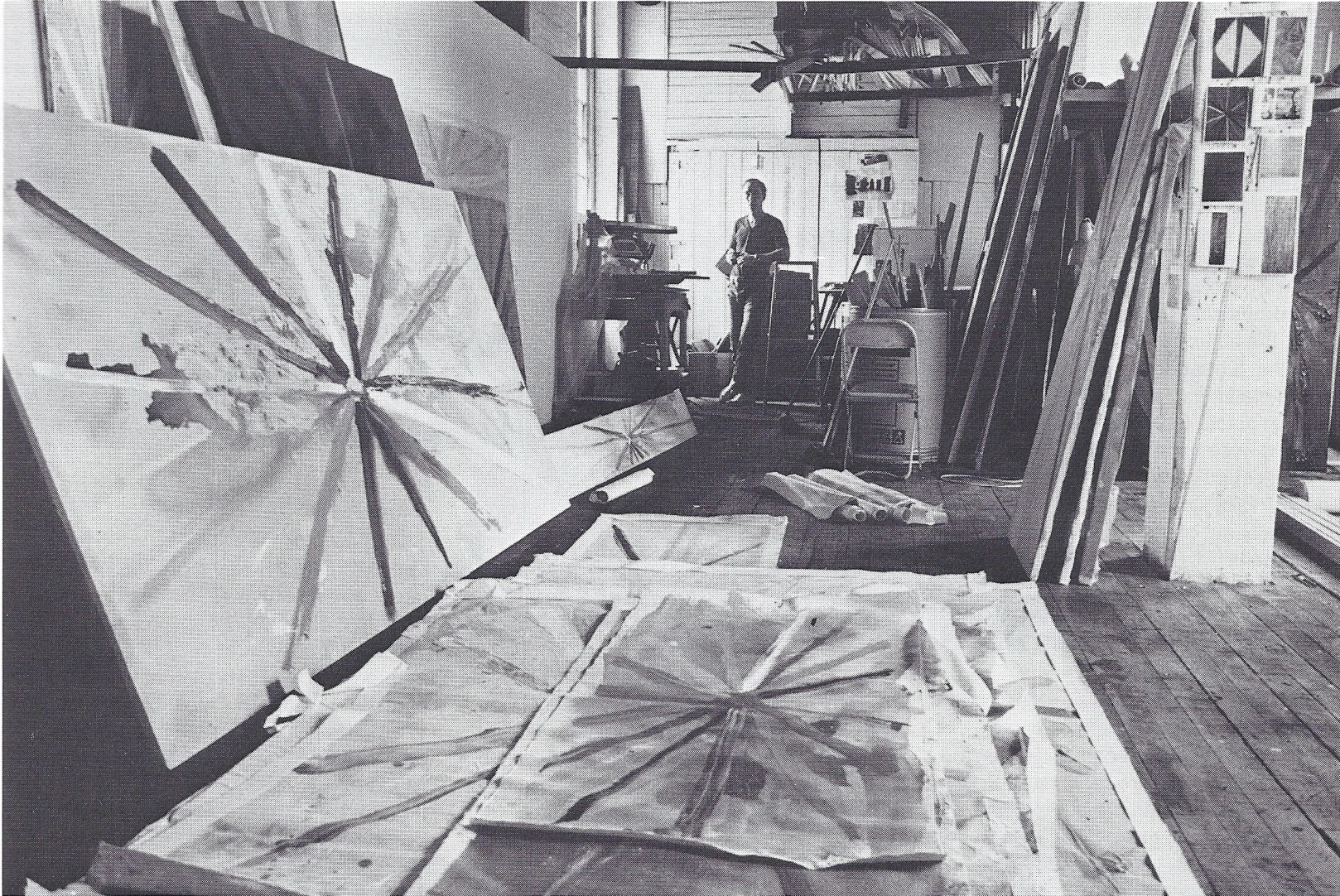
Feist had started his cross-Canada progress by the time the pale pictures developed. Some of the most elusive were made while he was teaching in Regina. The next series, made while he was teaching in New Brunswick, in 1975, were the beginning of the radial pictures, although, curiously, they are anticipated by a work on paper of 1970, in which pie-shaped wedges of color are isolated against a brushy field. The New Brunswick paintings were roughly square, each with a “wheel” of broad, overlapping strokes which all but obliterated the raw canvas of the ground. Their mottled scrapings, their earthy red and brown palette, and above all, their severely symmetrical format, seemed the antithesis of the pictures which had preceded them. The Regina paintings had been characterized by a few floating shapes of exquisitely pale color and by richly nuanced surfaces. It appeared as if Feist, having made his pictures as spare as possible in the Regina series, was now exploring possibilities of layering and elaboration, but in fact, the radial paintings of 1975 were related to the stained grid pictures of the early '70s. Like them, they were brutally immediate, and deliberately raw. As in the grid pictures, roughness was tempered by a rather rigid geometric structure, which in turn was warped and distorted by the very energy it attempted to harness. The layering and transparency of the wheel pictures was related to the all-over gestural fields of the paintings which had preceded the Regina series.
At the end of 1975, Feist exhibited the wheel pictures at Hart House, University of Toronto, in what was then his strongest show to date. Good as they were, Feist was apparently not sure how to deal with their symmetry and roughness, and continued to work instead with pale, elegant tonalities and eccentric layouts, in a group of triangular-wedge paintings, rather like fragments of his radial format, or of the old slashed grid, for that matter.
Over the next few years, it became increasingly clear to Feist that he wanted to use more color and a greater range of gestures and surfaces, but at the same time, to make pictures which would seem unforced and spontaneous. He experimented with a variety of centralized formats, in an effort to simplify composition, in order to give more play to color and drawing. Eventually, he realized that his wheel format of 1975 fulfilled all of his criteria. It was neutral, because of its radial symmetry and its forthright acknowledgement of the center of the canvas; it offered many places to put colors, because of its multiplicity of radiating spokes; it was variable. Feist quickly discovered that this austere, but flexible format allowed him great scope for expression — or rather, forced him to exploit the expressive possibilities of his medium. Something similar is true of Kenneth Noland's Targets: the deadpan image, generated by marking the center of a square canvas and reiterating that centralness, made nuances of edge and progressions of color enormously significant. Feist's radial image functioned in the same way. Not only did the color of each spoke become crucial, in relation to other spokes and the ground, but its density, expanse and the quality of its drawing became equally critical.
This is not to suggest that Feist's use of radiating spokes, since about 1978, has been a detached, systematic working out of permutations. Nothing could be less accurate. His radial paintings since about 1978 are impressive not only for their sheer quality, but for their extraordinary range. The fact of acknowledging the center is simply a way of beginning a picture. Composition is more or less given (as it was in the early grid pictures). So is the fundamentally repetitive gesture of the radiating spokes, allowing Feist to concentrate on variations of color and surface, on the physical act of painting itself, and on the vagaries of his medium, as he had in the all-over pictures of the early ’70s. The symmetry of the layout insures that attention is equally distributed over the entire surface, but the variation Feist can elicit from that symmetry is remarkable.
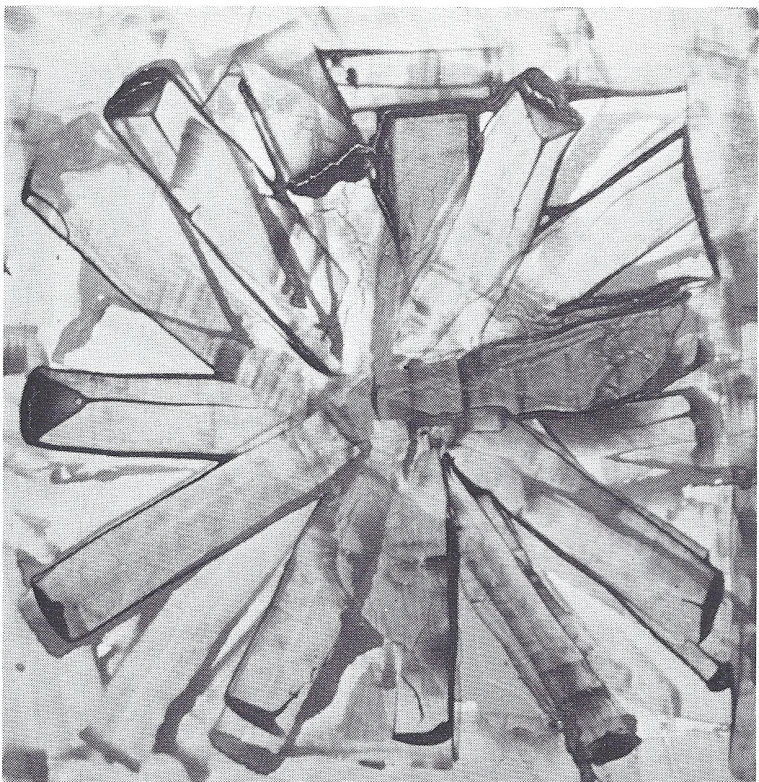
The shape of the support can vary from elongated rectangles to more or less regular squares. The configuration of spokes can be densely packed or very sparse, regularly spaced or eccentrically clustered. The spokes themselves can be broad or thin, precisely defined or elusively bled. And so on. Yet this sort of catalogue does nothing to convey the impact of the best of these paintings. Like the pictures of the early '70s, Feist’s recent works seem to continue the struggle between geometric clarity and unchannelled instinct, even unchannelled emotion. On one level, I suppose, this has something to do with the tensions Feist sets up between “cool” symmetrical, geometric layout and “hot” energetic, irregular facture, but the paintings are so full of complex oppositions that naming this simple confrontation of formality and informality doesn’t explain very much. It certainly doesn’t account for the success of the most arresting pictures.
Recently, Feist seems to have become dissatisfied with the essentially “figure and ground” nature of his spoke layout. He’s been a bit troubled by this all along, since he thinned down the broad spokes of the earlier wheel pictures. About two years ago, he began to paint his grounds with as much gestural variation as the strokes themselves. In these pictures, there was a danger of the activity of the ground and the direction of its stroking seeming too much at odds with the superimposed spokes. In his most recent work, the activity of the areas surrounding the spokes has come very close to dominating the image completely, so that the strokes no longer seem superimposed, but instead, often disappear, subsumed by the thickness and tonality of broader areas. (In fact, the spokes are frequently incised or scraped away, rather than overpainted.) These new paintings are far less about the relationship of figure and ground and far more about an all-over inflected surface. The inflections may or may not take the form of spokes.
The best of the new paintings are often close-valued to the point of being near-monochromes, enlivened by metallic powders or enrichments of surface. But there are no rules to the success of Feist's pictures. He is just as adept at managing an intense, varied palette of unrepeated hues. In the new pictures, though, the placement of the few spokes which remain visible seems particularly critical, far more so than in the more equally weighted, more symmetrical, earlier works. In the best new paintings, the spokes no longer seem immovably attached to the center of the canvas, but seem to float freely, aligning themselves only momentarily in their radial configuration.
The danger, of course, is that Feist’s layout may come to seem automatic or fail to stimulate him. So far, this has not been the case. Feist’s record shows that he has a history of challenging himself, of resisting the impulse to do what he knows he can do. The restless changes of the past decade are testimony to that, and the accomplishments of those earlier paintings certainly inform the works of the past three years. Feist has already produced an impressive body of work. There is every reason to believe that he will not only continue at his present level of achievement, but he will continue to intensify and deepen his pictures.
Footnotes
- These include the Maryland Regional Exhibition, Baltimore Museum of Art, 1968; Art Bank Exhibition, Centre Culturel Canadien, Paris, 1973; Canada x Ten, Edmonton Art Gallery and Art Gallery of Ontario, 1974; The Canadian Canvas, Canadian tour 1974–75; Painting in the West: Emma Lake and After, National Gallery of Canada and tour, 1975–76; Certain Traditions: Recent British and Canadian Art, Canadian and British tour, 1978–79. ↩
- In conversation with the author, 1981. ↩
- See “Three Painters,” Karen Wilkin, Artscanada, Oct.–Nov. 1972, pp. 57–60, for discussion of Feist’s early work. ↩